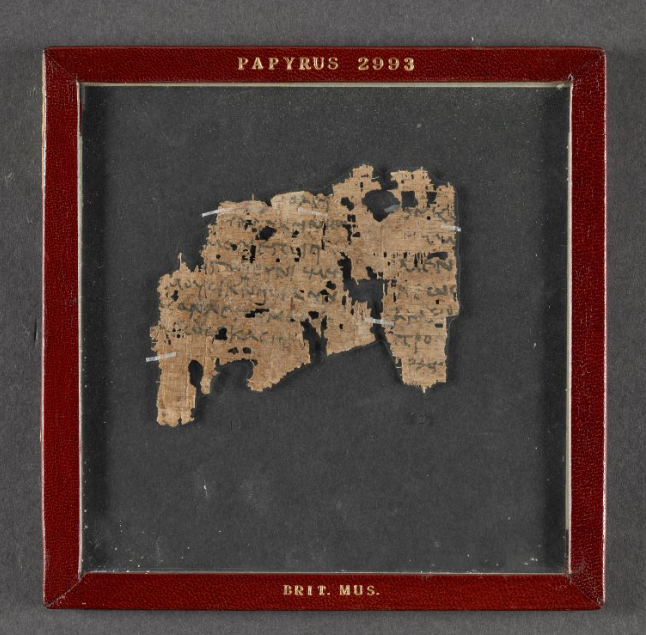
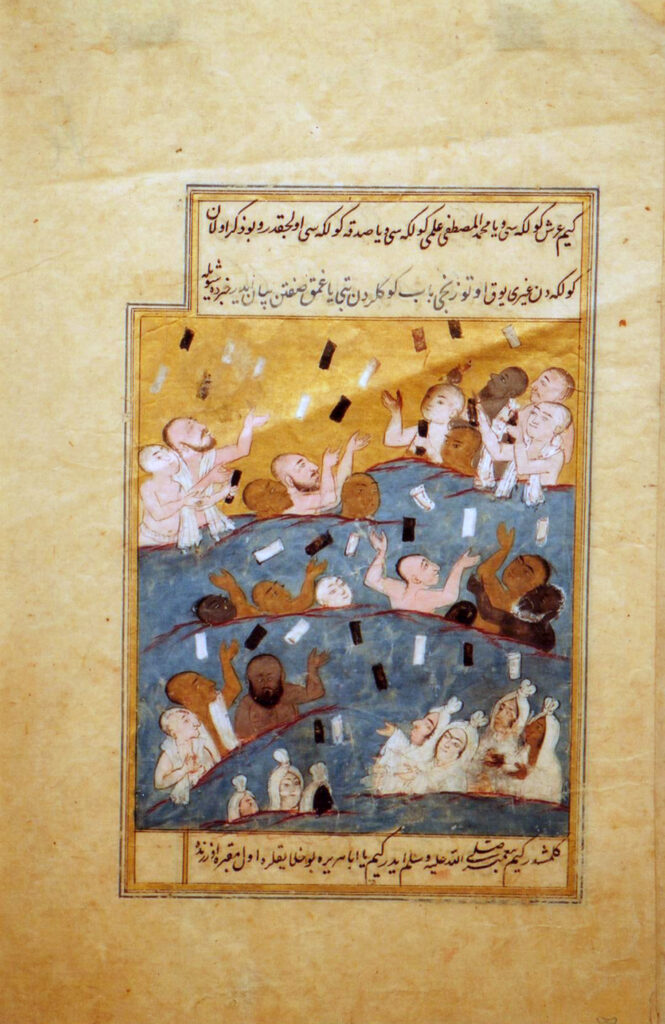
“Two small papyrus fragments jointly preserve two columns of text from the foot of a roll, with writing on one side only. Column i partially preserves seven lines of text from Plato, Sophist 223e4–224a2; column ii contains letters from six lines of text from 224b1-3, with ink from a conjectured seventh line faintly visible at the top.” Dated to 3rd Century BC.
A: The word itself has the taste of dim stuffy apartments with glitter of tiny oily icons wedged between cups and plates in the glass cupboard, it is stuffed with arrogant mysticism of tired adults, drenched in a sweet, sticky, suffocating smells and dark gold of ornaments in chapel shadows, transfixed in upturned glassy eyes. A knot of unpleasant childhood memories from within which stares the person dead set on action, a ventriloquized body, deaf to pleading, like a drunk, driven by “faith.”
B: To have faith is to be grounded in something that lay beyond the horizon of reason and proven true by a continuous succession of generations of believers. Each ritual in this procession is important. It’s reenactment rather than rethinking, it’s making the effects more real rather than question their origin.
Collective witnessing, as with sports, or cinema and theater – makes the ritual event and its symbolism more real. A mass of people experiencing a vaguely similar sensation with regulated interpretation. Mass politics, when they existed, relied on similar principles. Not only shared concerns, but also shared presence, which make the concerns much more material. That sense when fixed within an organized institution becomes transcendent, more than the sum of lives of the crowd.
When faith is organized, it’s a collective dance in which all movements and their meanings, even private ones, are pre-defined and where authority is transcendent in the words prescribing it, but also wielded by those closest to the scripture. It is a kind of moral and existential clarity provided in exchange for freedom.
C: Consider faith to be a bundle of ethical beliefs. Beliefs because the ethical principles may be untested or unfalsifiable within a lifetime, and so the validity of the principles is based on past examples extended infinitely into the future and into areas of life beyond the horizon of imagination. Our worldviews are often built in a hurry, rarely pausing for a moment to consider whether a specific belief held up historically. Instead, we often borrow the principle from someone else.
But faith as a bundle of ethical beliefs is still fixed within a series of experiences, often transmitted as images. What must be passed along through generations are not so much the reasonings but the feelings, the aesthetics which make the faith feel real.
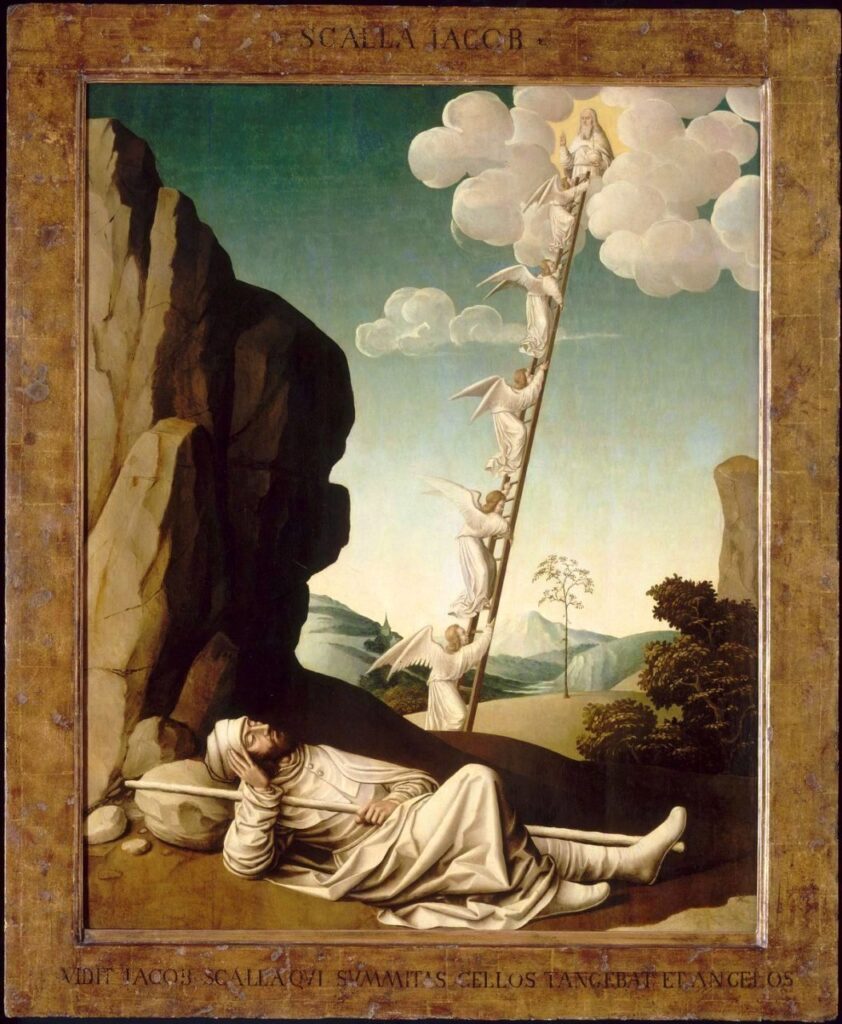
D: If I were to shut my eyes and imagine a theology to sum up my beliefs it would begin with images of the ladder, the void and the cloud. A ladder that extends into the infinite void of outer space and reaches towards the great clouds of dust. Unlike ladders of the Abrahamic religions, this Wittgensteinian ladder is not descended from above to symbolize spiritual ascension and fateful struggles depicted in Jacob’s dream, but explicitly a human construction, an ascent by reason into eternity.
E: Distances and masses unimaginable within the scale of human lifetime constitute our image of the outer space. The void between celestial bodies is so large, we have invented units such as light year to measure the immense expanses of the universe. A purely hypothetical way of crossing vast distances, tied to what we can conceive as physically possible – the distance covered by light traveling at constant speed in a vacuum for 365,25 days, – does not reflect our own physical capacities. It is the speed at which our sight can travel, but not our bodies.
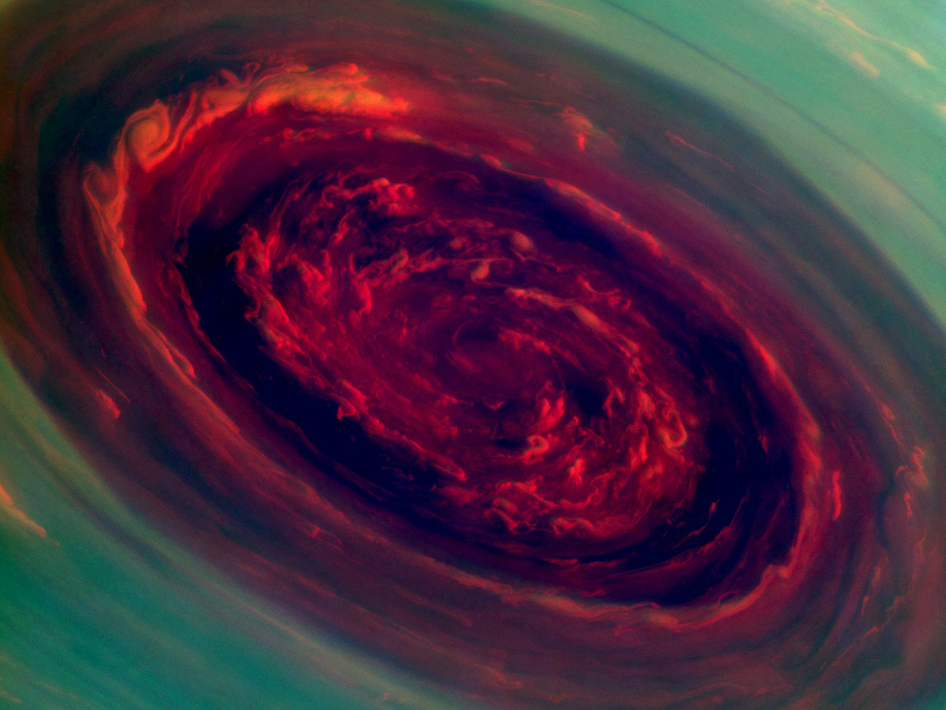
Even within our own solar system, planets possess an almost unimaginable scale. Our planet Earth, our whole known world, is smaller than one side of Saturn’s hexagon – a jet stream of atmospheric gasses moving at extreme speeds with a massive vortex in the middle. Canyon valleys Valles Marineris of Mars rival continents on Earth, stretching over 4000 kilometers from Noctis Labyrinthus to the basin of Chryse Planitia. The Great Red Spot, a hundreds years old storm on Jupiter could swallow multiple Earths. It’s difficult to imagine the scale of these alien phenomena compared to one’s body, the units of measurement are simply crowds of numbers. Instead we measure them with conceptual analogies. We compare them to known objects and places. We explain their existence with theistic or alien agency, intelligent design, or rule bound natural sciences domesticating nature. This desire to feel everywhere at home by inscribing human topos on the unknown is the core aspect of human cognition but also theology built around “felt truths” and familiar explanations extended into infinity of outer space.
Outer space is still the most convenient way to imagine what noumenon looks like, the world as it is and not how we feel or think it. A dizzying, potentially infinite pool of galaxies suspended in a void at distances no human life can encompass. And yet that sense of vertigo can also be encountered here, on planet Earth, in microscopic variation most manifest in stumbling into a reservoir of nature we have not yet transformed. Wander too far into a forest away from the whisper of car tires on tarmac and drown in alien sounds, feet sinking through the deep moss above the invisible ground. Dive two meters deep into the sea and mass of water begins to swallow sunlight, where flocks of fish converse in clicking voices just beneath. All told a tiny edge of an immense abyss of busy existence smaller than our own. Glance into a microscope at a fleck of dirt and the starry sky above will seem impoverished compared to the abundance and diversity of microscopic life. One only has to imagine the extent to which we, who are stuck in existence on one physical scale only – that of discreet objects, are teetering on the edge of an abyss of other dimensions, other forms of existence. There we can only visit temporarily, either with our imagination or our sight, limited by our bodies but extended by prosthetics of technology, much as we are limited to visiting far away galaxies with our telescopes only, themselves limited by the speed of light.
F: There was a time when all we had were domesticated explanations, as manifested by religious explanations of nature and its functions. A theistic entity would be a guarantor of not only moral rules for humans, but also of rationality of nature as an extension of god’s will. Exceptions and interjections would occur now and then, all conveniently on part of human history, as gods would shape nature around limits of human imagination and give it familiar telos. An overall guarantee that Sun would rise daily, seasons would come in familiar order, animals would behave predictably and the universe would continue turning around the fixed center of human point of view. God would be a source of order, to doubt god would be to doubt natural order, to deny the powers of spirits would be to interfere with the workings of that order. Within this order the universe would have a beginning and an end, so would humanity. Metaphorically these rules created a closed, complete explanatory system in which everyone and everything had a fixed role. Everything was grounded and explained deductively, if not directly, then by an extension of hermeneutics of what already is clarified.
A Copernican revolution has gradually displaced humanity from the center of universe, but not the idea of order. Perhaps God is not neccessary to guarantee daily sunrise, but the immense forces of gravity warping timespace around the Sun are. Turning Earth around itself, these forces exceeding a single human life and likely the entire human civilization, will raise the tides on this and we assume all other planets, long after we are gone. Their power does not rely on our understanding of it. But they can be measured and their lifetime estimated. Domestication within the familiar home of human imagination is no longer a required limit and the Sun will rise daily whether we exist or not. This universe of inhuman scales and forces is where we must make our mental home, however uncomfortable or uncanny. We have to learn to live in the middle of nowhere.
G: In the worldview prevalent today postulating not what is known, but what is potentially possible according to the possible that is known – a process of hypothesis building that is for example theoretical physics – leads us to a place of being no longer sure of where the ground is. Philosophies of science insist that we do not indulge in building hypotheses on top of other hypotheticals, that theory must touch down the real as often as possible, lest science turns back into whimsy. We don’t know the size or the length of the universe, but we have estimates. Nor do we know for sure what it’s history is, but we have theories, and we know that it is indeed not turning around centered on human point of view. A world of facts excludes irregularities such as magic and demiurge intervention mostly on the assumption of regularity of what we take to be physical laws of nature writ large. That regularity finds its confirmation in experimental science, something that ironically has roots in alchemy and magic. Even so, we’re still stuck in some categories when speaking of the universe – such as the criterions of being and existence. It is an utterly alien world where we are stuck in one of its scales – the object scale, – while there are many others.
In this void we formulate the principles by which universe ticks as rules along which our hypotheses are formed. Central to this is the belief that pure math is not a purely formal game, but a reflection of the play of elements and forces putting the universe in motion. Therefore by playing the formal game, we might get access to the language in which these forces speak. It is this faith that gives us strength to take the aspects of this formal play and attempt to extend its rules into the void. Our rules are extended into outer space like a shaky ladder. It is suspended only by our own collective efforts, building itself upwards and outwards. But just as with the Abrahamic ladder, we can easily fall of the ladders rungs. Unlike the Abrahamic ladder, our ascent is not guaranteed by a prophecy, no principle of plenitude to guard the inevitable progress.
The vision is a familiar one: science as a loose set of disciplines bound together by rigor of methodology or by the truthfulness of its outcomes in form of technological artifacts, which have the goal and the justification of progress. But this vision, at its peak on both sides of the 20th century Cold War, was a mere transformation of a point of view not of circumstances: instead of social transformation now it offloaded the idea of progress to technological innovation in shape of national achievements or consumer products; instead of reassessing the present material and political conditions of life, it was a rationalization of the status quo. In other words the kernel of the economic science underpinning this vision was also theological, except the main dogma was and to this day still is – growth.
It is in that age that the idea of going to the stars seemed decided and within reach. Science fiction was a direct reflection of economocentric worldview – future as mere infinite extension of the line going up. We no longer live in the material circumstances where such ideas seem to naturally follow. It might be a world with more comforts for some, but the comforts now entail a sense of nihilism about defending these rare benefits amidst the turmoil of consequences from a century or two of the line-goes-up hegemonic view. In a world of rapid climate change and scramble for growth, resources and dismantling of liberal worldview, the timeline shrinks rapidly and the future of space travel seems to recede. Just as most of us think that we personally will not have to live in the scary world of dramatic climate change, but the following generations might, we no longer think that we personally will go to the stars. Mars colonization and terraforming are empty fantasies unless we find a way to create a magnetosphere. Our ideas of omnipotent AI rely on simultaneously replicating our own linguistic models of the world and expecting immediate progress from free combinatorics of existing knowledge. The distance between our generation and those of star colonizers might as well be measured in parsecs.
H: At the same time even the scientistic worldview crumbles. The wonders of contemporary hard sciences are many, but most can be appreciated only after a lifetime within the discipline. Despite the previously popular belief that hard science facilitates technological progress, it does not appear enough anymore as a worldview that carries our daily concerns and beliefs. The march of technological progress is constituted by the existence of institutions, collectives of researchers but also on wide adoption of its fruits in the society. Much like the water wheel invention made little impact until it was widely adopted, contemporary technological wonders are now ultimately filtered not only through consumer products but also through financial speculation and privately funded research. Both of these serve as a filter and vector to said research, to the extent that private capital subjects epistemologies of hard sciences to the idea that truth has economic value. Such direct involvement of academic researchers into the commercial industry as in the field of machine learning only underlines the public cynicism about the class divide between those with a scientistic worldview and everyone else.
It is time for us to imagine a future in which we never get off this planet, where technology displacing social ills is never invented. Science fiction might be perceived as light hearted indulgence into extending the present optimisms, but it also quietly reflects the space of social imagination about its future. It is no longer in sync with our actual futures despite the present prevalence of post-apocalyptic aesthetics, and the attempts to imagine a different social formation in which not only surviving but living is possible are still rare. True science fiction ought to be social fiction.
I: The sense of here and now is all that matters to us all – the living. It is the obstacle to an ideal belief that all religious movements seek to overcome and in the process cross the boundary between what is ethical and what is convenient, each in its own corrupting offer of extending the here and now past the point of individual physical death. But such continuity of existence past the inevitable death is already embedded into our societies – life after death exists for everyone who manages to survive in form of memories shared among the living. Ghosts of course are very real: mental manifestations of a memory of a lost person, ambushing you at surprising corners of your mind, hard to shake off, gradually detaching themselves from factual memories and into the realm of “what would this person say/do” where a ghost almost has its own life. It is most often loss without the sense of closure that leads us to reminisce a mnemonic construct of a person we’ve once known, or feel as if we’ve known. And it is only a small step from there towards an imaginary, but nagging conversation conjured by assuming that we can imagine what that person could have said or done. They are no longer here to tell us otherwise.
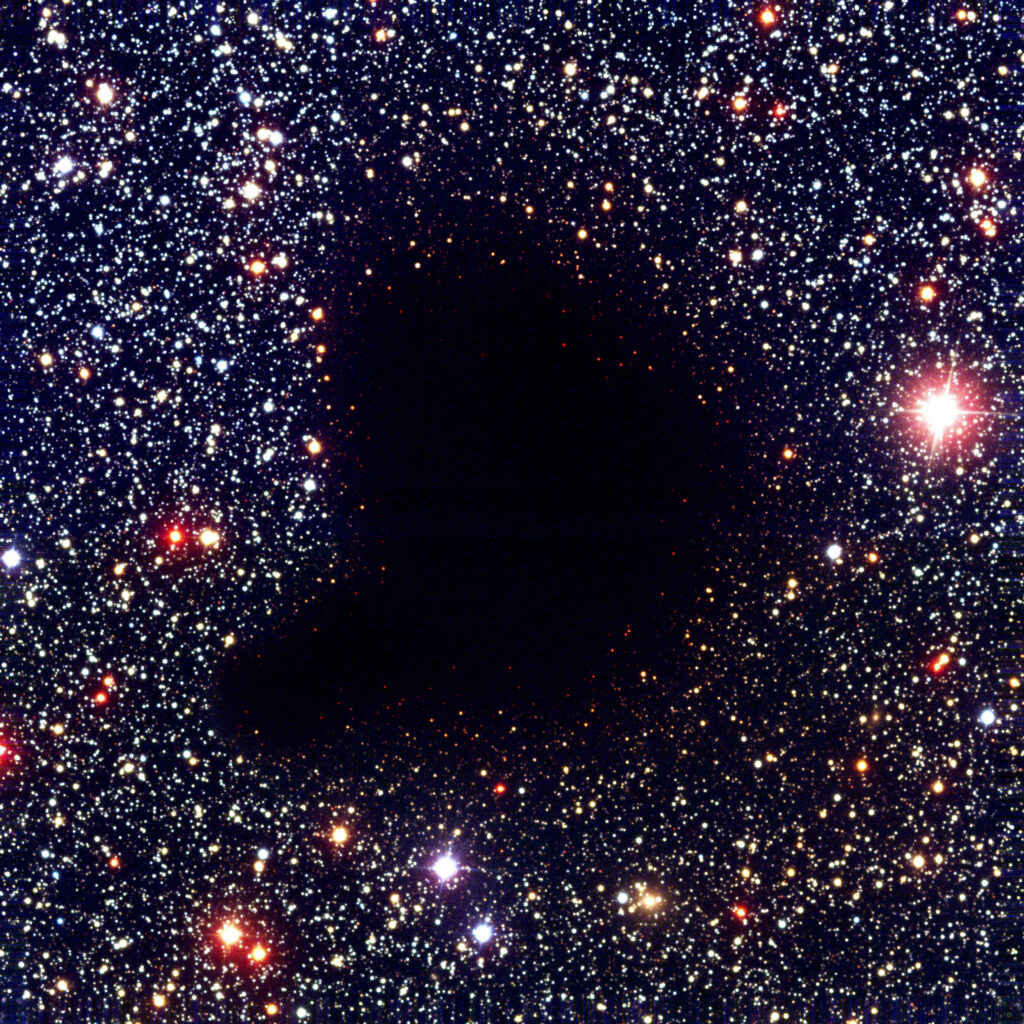
J: Half a light-year across, opaque to visible-light wavelengths, it’s mass twice that of the Sun, the molecular cloud Barnard 68 is most famous to us as an image which is mistaken for the image of Bootes Void – a nearly 330 million light-years across void in observable universe with little to no galaxies within. Barnard 68 will collapse within 200.000 Earth years and become a star. I would like to visit it, and touch the cloud. I never will, not as a body in space.
The sense of distance between the bodies in outer space, a distance measured in light years, is crushing. It is a sense one can only physically apprehend by comparison to known, imaginable, experience-able quantities. Such as for instance the understanding that no one who could possibly read these words would witness human space travel to another, even the closest star. And yet, because the culture, as we build it is always a gradual process where one individual is in a dialogue with another – living physically or only in the memories, perhaps in fragments of long lost books, – it is my belief that I, we, could be a ghostly presence within the infinitely extending ladder of human culture that reaches out into a void to touch an interstellar cloud or get lost in the dark nebulae.
The ladder reaching into to the cloud through endless void is also the endless chatter of human civilization, a conversation in which things are constantly based on what has been said before – in daily life, in science, in technology. Individual lives may not matter from a high level view of statistics, but to each of us they are all that is visible. Preserving the stories of such lives as memories could also be done institutionally as a great library of all the past voices. These voices aren’t lives exactly – even in our diaries we don’t write down everything precisely, nor are all sentences made to be spoken or even written down.
K: Elsewhere there are cosmist ideas of total resurrections of all past lives or science fiction speculations about uploading a mind, preserving it as information in a silicon substrate. Or perhaps more presciently, the idea of creating chatbots trained on information about specific people to become a kind of contemporary ouja board. But I think these ideas are missing the point of what makes the individual voice special and interesting to read or hear. It is not the relatively invariant tokens, statistically likely and similar to others. It’s the aberrations, the personal filtered through layers of personal, the occasional stray thoughts and accidental choices. Personhood is constituted by series of decisions akin to getting off at the wrong train stop, over and over. Whatever sticks in our memories for years after is often the out of ordinary. Meanwhile the advice against monotony of life and the sense of time passing too quickly is to diversify, to not fall into routines. I find it very difficult to imagine how this could be captured in a statistical model built on outside information not provided by the person modeled. Although I don’t think that in the long run the issue with the storage of aspects of personhood won’t be solved by means of technology.
L: In his book Plow, Sword and the Book, Ernest Gellner argues that writing historically creates transcendence. Written voices and characters, unlike those who exist only in oral language, acquire a life of their own independent of the bodies of their authors. They therefore also acquire an authority that transcends individual human lives and open up the path to either god’s voice or the laws. This transcendence of a record could be applied to individual voices as well.
Until recently no one would seriously wonder if this transcendence exists independently of our ability to read those voices. Although merely a thought experiment, the idea of autonomous ai agency has become mainstream. And that idea does raise the question of existence of a voice when no one is around to hear it.
On the flip side is the question of what happens when we read a text and it’s aesthetic affects us. There is a sense in which the voice of the text becomes our own voice inside the head (unrelated to vocalizing when reading). That the movements of music become our own rhythm and likewise the movements of the text become the movements of our own thinking. It is of course not like hypnosis, we can always put the book down or simply think in parallel to reading, thus breaking the spell. But when things go well enough, it is akin to thinking a different life. A similar thing happens in writing, when sentences flow out of each other rather than follow the author’s plan. A person might ostensibly be writing down an entry in their diary, but they might also be writing down an entry from a purely imaginary life.
Even so, the life imagined is rooted in the actual one. And in a hypothetical library of voices, even a fantasy someone had is indicative of their own voice.
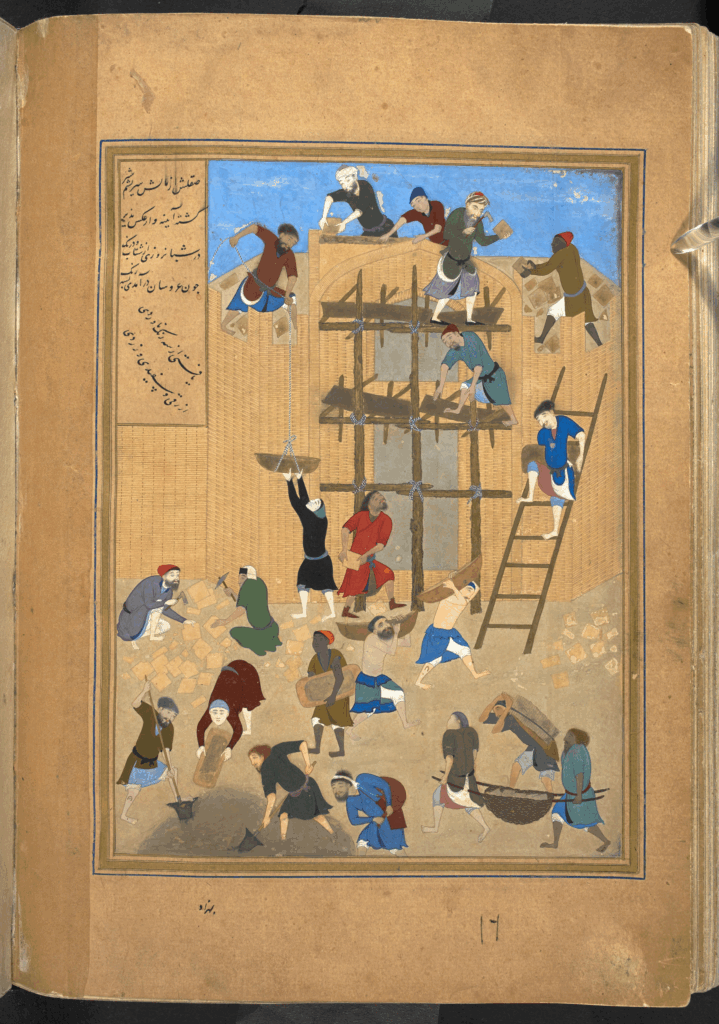
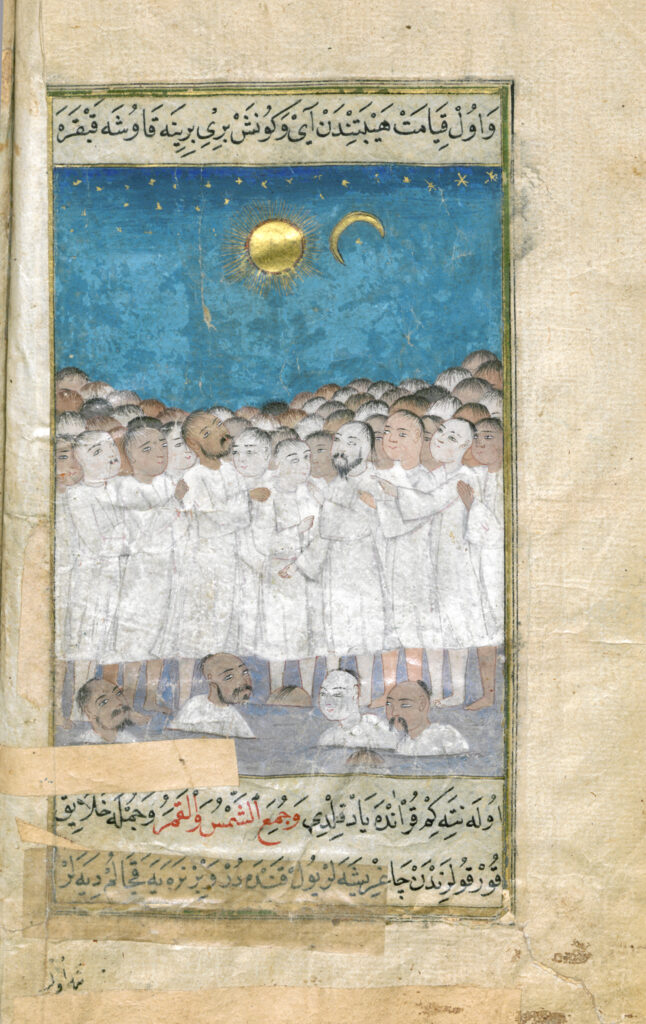
from a 1494-1495 copy of the Khamsa (‘Five Poems’) of Nizami.
M: All that said, it remains open what such a story offers in terms of salvation or hope for an individual now. What is the relevance of this “faith” to those who are subject to genocide? What are the ideals to follow? What is the authority that is both the source and the judge of those ideals?
Telos cannot be the authority – this is the mistake on which long-termism or EA is built. Because like a god, telos has neither voice nor precisely determined principles, so it is always subject to intrepretation through which it becomes intelligible. This interpretation itself is always dependent on the person performing it. In practice this means passing often naive beliefs for eternal truths, a kind of self eliminating circle of interpretation, where there’s no universal telos unless it is measured in a utilitarian way.
N: To imagine a future we might have to travel back along the thousands years path made by thinkers hiking back and forth between ideas of god and nature, mind and soul. Respectively, the terms are interchangeable. But it ought to remind us that in the circumstance where our future is bound to this planet, the eternal guarantor and judge for humanity is always nature. With minor changes to its moods, our lives shall follow suit. These are the real stakes, perhaps not involving eternal alien agency, but played out on an existential scale for us and against forces we must obey.
To add to the forces from above, we must also deal with our own predicaments in order to have a future. To imagine a future in which we not only survive but live, in which our ghosts, our histories survive into an age where the ladder of human civilization extends beyond the atmosphere of our planet, we have to imagine social formations which are more than reifications of present conditions.
O: There is nothing any faith can offer to a people in the time when they are subjected to genocide, except forgetfulness for a brief moment in ritual of thinking that there was a past and there will be a future.
But to those of us who are lucky to not live our our lives in the crosshairs, it is a stark reminder that mass murder in one corner corner of the Earth is a sign of things to come for us as well. If we choose to live in the present where such things are possible, then we choose a future in which we will be subject to the same violence. It is this, and not the fantasy of a dark forest that is the realpolitik of the present.
P: Having descended in a spiral of thousands of words, I must stop relegating the answer and finally spell it out. I must believe the prose and poetry of books on my shelves is sharp enough to constitute and pin down all the ways I can feel about the world, that it is a library of metaphors and ideas that has enough words to encompass the entirety of human existential truths. That it is a language public enough for all the emotions and memories of my life to not be lost in time as mere few synapse signals. I must think this existing cultural legacy gives me enough language to feel human, to think of daily things, to have concrete yearnings, to have ideas, to have plans, to imagine futures. I must believe that despite aesthetic value being not autonomous and thus permanently beholden to whoever can effectively wield power over the distribution of culture and its flavors, and despite fandom being the long sought after mythical force of actualization of art as world changing, despite all of these constraints and limitations I still have agency, even if shrunk down to the size of one single person with a pencil in the corner of a very large and crowded room. I must believe simultaneously into individuation and the homogeneous continuous flow of endless communal human dialogue or else I’m lost adrift in the currents of human history. Or else I’m lost in the endless present like Pavlov’s dog tricked and triggered by the stimulus of commercial culture and political dog whistles, existing like an automaton. Outside that endless human dialogue there is only darkness, a void no less infinite than that of universe or death, over which only a ladder of human conversation extends.
By Alexey Vanushkin